Cloud-based storage, products and services have become a battle scene for market leadership and the creation of new business opportunities. Nowadays, many companies have their business based in the cloud and, in particular, their data storage services. For all of them, APIs are essential.
Amazon, Microsoft, Google, Dropbox, Apple and OpenStack are some of the examples of competitors in the market, but there are some smaller companies that are doing their job with great talent and courage; one example of this is Box. For all of them, Application Programming Interfaces (APIs) are essential.
This is intended to be a list of some of the most important cloud-based storage APIs on the market. Many coordinate exchanging data between systems infrastructures of companies or users with final solutions and tools that they use in their day-to-day activities: Amazon for Web Services; Google for its cloud-based applications; Microsoft for its office automation tools; Dropbox for its cloud-based enterprise storage service; or OpenStack for user authentication.
1. Amazon S3 API
Amazon S3 (Amazon Simple Storage Service) is the platform of the company led by Jeff Bezos which offers cloud storage to systems infrastructure developers and professionals. Amazon S3 is often used with the company’s other services such as Amazon Elastic Compute Cloud (Amazon EC2), the cloud-based computer system for running applications, and AWS Identity and Access Management (IAM), the Amazon user authentication system.
The Amazon S3 API is still available for SOAP systems, but the company itself recommends to start using what will be the future: either the REST API or the SDK for Amazon Web Service. When developers make requests to Amazon S3, they can do so as authenticated or anonymous users. Each request made by authenticated users automatically becomes an authenticated request. In the case of the REST API, each call directly from the code creates a signature or valid credential that is included in the request to that API. Making these requests directly in code is complicated.
For that reason, Amazon S3 proposes several interesting alternatives to make requests with authentication credentials directly to the service:
Amazon Web Services SDK: The SDK’s customers access through a key service that already authenticates the subsequent process.
Google provides two APIs for storing cloud-based information and data: it has an API in JSON format (Google Cloud Storage JSON API) and another application development interface in XML format (XML API).
Characteristics:
Google Cloud Storage JSON API: the search has a lot of libraries that allow developers to work with all of the company’s APIs, including its storage platform, but not all are well optimized to interact with the Google Storage JSON API. Now, Google Cloud Platform does have a number of client libraries that combine perfectly with the specific APIs for cloud-based data storage. Especially the API in JSON format. These libraries use default credentials that authenticate the whole process of requests sent to the application development interface.
Google Cloud Storage XML API: is a REST API for managing data within the Google cloud programmatically. The API, like all REST, is based on the method of standard HTTP requests: POST, HEAD, PUT, GET and DELETE. An interesting question is how Google allows users of Amazon S3 to migrate all applications that use the service of Bezos’ company to its Google Cloud Platform. For that all that needs to be done is to change some of the libraries that Amazon customers already use, although they cannot take full advantage of Google Storage; or a somewhat more complex migration incorporating some major advantages such as including OAuth 2.0 as an authentication protocol.
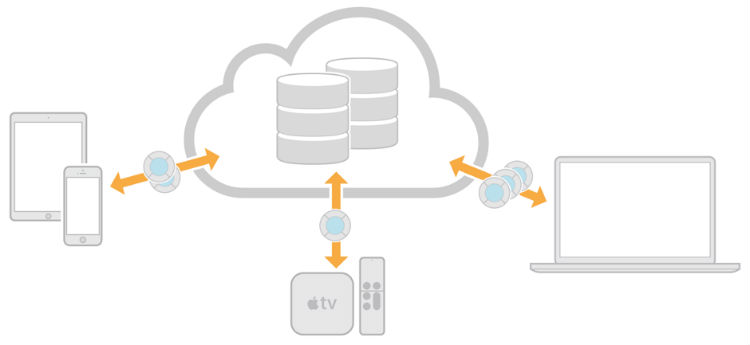
iCloudKit makes it easier for programmers to create native applications that store user data in iCloud. This is what enables different Apple users to seamlessly access the records stored in the database of an application from any device. As an example, users can generate new records in their database as registered users on Apple from their iPhone and access that information seamlessly from another device such as an iPad, a Mac or Apple TV.
4. Dropbox API
Today, Dropbox has a large number of SDKs to integrate its platform and services with third-party applications. It has Development Kits of applications in various programming languages: Swift, Objective-C, Python, .NET, Java, JavaScript and HTTP. When developers make calls to the Dropbox API, now in its second version, each application requires a certain level of client authentication. If the programmer who is making requests using some of the company’s SDKs, the kit itself is responsible for that detail. Now, if the developer prefers to use the Dropbox API through calls based on the usual HTTP method, you need to apply the appropriate authentication type for each endpoint. The protocol used by Dropbox is OAuth 2.0.
5. Box API
Box is a company that provides services related to the content and management of cloud-based data storage to third-party customers. Within its business sector, it features REST APIs that facilitate the whole process for developers and the integration of its products with the platforms and services of other giants like Google, Microsoft, IBM, Salesforce or Apple. To begin working with Box all you need to do is open an account within the platform, register an API key and then start making calls to the interface itself.
Banco Bilbao Vizcaya Argentaria, S.A. owner of this portal uses cookies and/or similar technologies of its own and third parties for the purposes of personalization, analytics, behavioral advertising or advertising related to your preferences based on a profile prepared from your browsing habits (e.g. pages visited). If you wish to obtain more detailed information, consult our Cookies Policy.
Cookie settings panel
These are the advanced settings for first-party and third-party cookies. Here you can change the parameters that will affect your browsing experience on this website.
Technical Cookies (required)
These cookies are used to give you secure access to areas with personal information and to identify you when you log in.
Name
Owner
Duration
Description
gobp.lang
BBVA
1 month
Language preference
aceptarCookies
BBVA
1 year
Configuration Accepted Cookies
_abck
BBVA
1 year
Helps protect against malicious website attacks
bm_sz
BBVA
4 hours
Helps protect against malicious website attacks
ADRUM_BTs
Salesforce Marketing Cloud
Session
Required for monitoring of the service, inherent to SFMC
ADRUM_BT1
Salesforce Marketing Cloud
Session
Required for monitoring of the service, inherent to SFMC
ADRUM_BTa
Salesforce Marketing Cloud
Session
Required for monitoring of the service, inherent to SFMC
ADRUM_BT
Salesforce Marketing Cloud
Session
Required for monitoring of the service, inherent to SFMC
xt_0d95e
Salesforce Marketing Cloud
Session
Remember user preferences (if any)
__s9744cdb192d044faa1bf201d29fafd1e
Salesforce Marketing Cloud
Session
Remember user preferences (if any)
wpml_browser_redirect_test
WPML
Session
Text translation in the portal
wp-wpml_current_language
WPML
24 hours
Text translation in the portal
Analytics Cookies
They are used to track the activity or number of visits anonymously. Thanks to them we can constantly improve your browsing experience
Your browsing experience is constantly improving.
With your selection, we cannot offer you a continuously improved browsing experience.
Name
Owner
Duration
Description
AMCV_***
Adobe Analytics
Session
Unique Visitor IDs used in Cloud Marketing solutions
AMCVS_***
Adobe Analytics
2 years
Unique Visitor IDs used in Cloud Marketing solutions
demdex (safari)
Adobe Analytics
180 days
Create and store unique and persistent identifiers
sessionID
Adobe Analytics
Session
Launch's internal cookie used to identify the user
gpv_URL
Adobe Analytics
Session
Adobe Analytics plugin: getPreviousValue Capture the value of a certain variable in the following page view, in this case the prop1
gpv_level1
Adobe Analytics
Session
Cookie used to store the DataLayer levl1 of the previous page.
gpv_pageIntent
Adobe Analytics
Session
Cookie used to store the pageIntent of the previous page.
gpv_pageName
Adobe Analytics
Session
Cookie used to store the pagename of the previous page.
aocs
Adobe Analytics
Session
Cookie that stores the first values collected at the beginning of a process.
TTC
Adobe Analytics
Session
Cookie used to store the time between the App Page Visit event and the App Completed event.
TTCL
Adobe Analytics
Session
Cookie used to store the time between the LogIn event and App Completed.
s_cc
Adobe Analytics
Session
Determine if cookies are active
s_hc
Adobe Analytics
Session
Cookie used by Adobe for analytical purposes
s_ht
Adobe Analytics
Session
Cookie used by Adobe for analytical purposes
s_nr
Adobe Analytics
2 years
Determine the number of user visits
s_ppv
Adobe Analytics
Permanent
Adobe Analytics plugin: getPercentPageViewed Determine what percentage of the page a user views
s_sq
Adobe Analytics
Session
ClickMap/ActivityMap features
s_tp
Adobe Analytics
Session
Cookie used by Adobe for analytical purposes
s_visit
Adobe Analytics
2 years
Cookie used by Adobe to know when a session has been started.
Advertising Cookies
They allow the advertising shown to you to be customized and relevant to you. Thanks to these cookies, you will not see ads that you are not interested in.
The advertising is customized to you and your preferences.
Your choice means you will not see customized ads, only generic ones.
Name
Owner
Duration
Description
OT2
VersaTag
90 days
VersaTag Cookie used to store a user id and the number of user visits.
u2
VersaTag
90 days
VersaTag Cookie where the user ID is stored
TargetingInfo 2
MediaMind
1 year
Cookie that serves to assign a unique random number that generates MediaMind.
Customization Cookies
These cookies are related to general features such as the browser you use.
Your experience and content have been customized.
With your selection, we cannot offer you a continuously improved browsing experience.
Name
Owner
Duration
Description
mbox
Adobe Target
9 days
Cookie used by Adobe Target to test user experience customization.
Looks like you’re browsing from MexicoSpainArgentinaPeruColombiaBelgiumChileUSAFranceHong KongItalyPortugalUnited KingdomTurkeyUruguayVenezuelaAlemania, so let’s show you the custom content for your
location. Change
Select a country
In order to access the private area and corresponding sandbox, select the country of the APIs you want to use.