API World

News and case studies on embedded finance, APIs and much more

4 min reading

| 02 NOVEMBER 2016

Three platforms to make the most of your mobile application

It is one thing for a company to have one or more mobile applications; however, it is a very different thing for those digital and business products to be optimized for their end purposes, the most important of which is to satisfy a specific user need. It is true that there is quite a large current offer of platforms and tools for average users or even professionals with more experience to detect the various flaws that prevent applications from serving their purposes.

All these tools have an essential reference point, which is the measurement of the specific data that reveal the success or lack of success of a mobile application. If the developer has a clear and concise list of goals and understands the product’s success metrics, these tools can become a blessing:

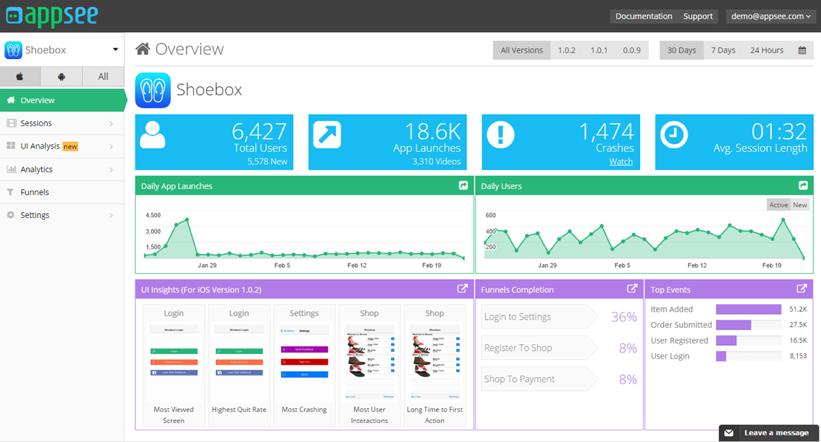
1. Appsee Mobile Analytics

Appsee is a tool that can be used by a developer or project manager to measure any type of user intervention while the user is using a mobile application. Some of its most interesting and useful features are:

  • User recordings: the Appsee customer can make test recordings or record how an application is used. Thanks to these recordings, seasoned eyes can detect possible problems in adding purchases to a shopping cart in a website that uses e-commerce, why users interrupt registration processes or logins, processes involving bugs on screens or specific actions, etc. The tool is very visual and powerful.
  • Creating automatic events: Appsee not only allows recordings of movement flows between environments, but also generates a repository of actions or events in the app itself, while measuring times.
  • Heat maps: these types of reports are usually quite effective to answer questions about which part of the screen is the most attractive for users, which buttons are the most attractive to the customer, which commands are not serving their purpose, which elements can be enhanced because they are effective and which can be eliminated because the opposite is true. An efficiency analysis of UX study processes.
  • Real time analytics: real time analytics allow Appsee users to understand more accurately what motivates and frustrates end users of a mobile application. Discovering user movement flows between environments and screens, where they spend the most time, what interests them and what makes them leave or remove the application, measuring all the aspects of the user interface to avoid pain points or generate WoW moments in users that will increase their loyalty and commitment.

  • Conversion funnels: conversion funnels are essential to measure at what specific points users have lost their way on a path in the application to obtain sales, records or any other item that can monetize the product. Detecting when users cease to do what we expect is essential for the success of an app.

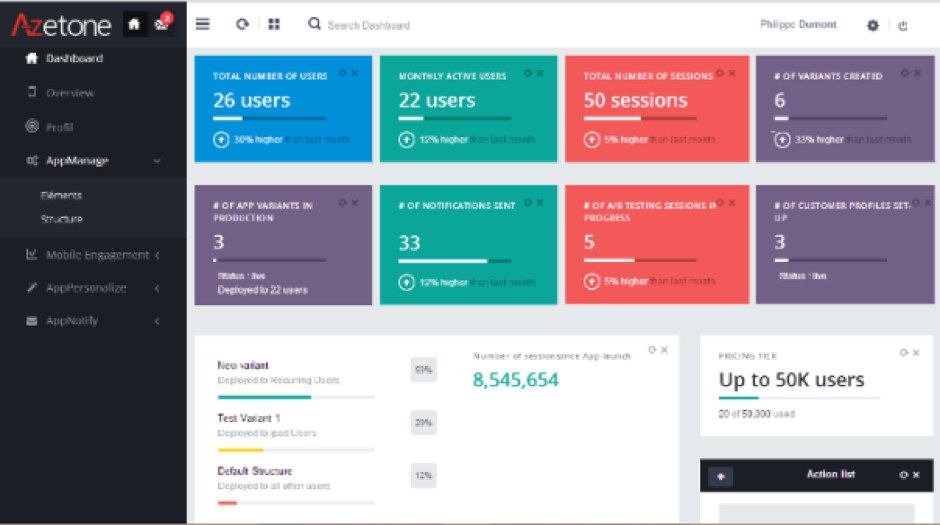
2. Azetone Mobile AB Testing and Personalization

Azetone sells its customer three easily distinguishable services: user experience analytics, A/B tests for mobile applications and personalization services. All these in a user interface that is as accessible as possible for the end customer, including clear metrics and colors to simplify data access. This is the interface:

  • UX analytics: Azetone uses different kinds of reports, like heat maps or movement flows between environments to measure all types of actions (swipes, zooms, panning, touches, etc.), with various metrics that are sorted in simple screens that can be downloaded in standard formats like CSV and used in other business intelligence platforms (Tableau or Qlik) or specific platforms like PowerBI, the platform for viewing complex data created by Microsoft.
  • A/B testing: to perform tests with users, Azetone has its own SDK that can be integrated in the mobile application being used for the study. One of its main advantages is that it is supported by most of the push notification services and CRM services on the market, so A/B testing can be performed with the majority of the customer’s users.
  • Personalization services: this can be used to adapt user experience, based on who the user is. We are on the verge of generating hundreds of applications in one, with all the advantages that implies in increasing commitment and achieving the conversion goals in the application.

3. Applause

Applause’s core sales pitch is a large international community of testers for mobile application, web projects or the Internet of Things initiatives. The company boasts more than 250,000 testers in more than 190 countries, equipped with 400,000 devices in all the environments possible. This implies a high degree of raw strength to test applications and solve user experience problems before or after an app is launched.

This kind of mass testing is known as crowdtesting, a mechanism in which all the testing processes are outsourced to professionals outside the internal and more convenient environment of the company, in “sterile laboratory environments with real people, using real devices and at real locations”. It is evident that this type of activity has its advantages; however, it also has certain disadvantages, such as an increase in putting confidentiality at risk, especially as regards digital products that have not been launched yet on the market.

Some of the services offered by Applause:

  • Functional tests and test automation: Applause has a community of betatesters and testing automation by using scripts. A powerful combination to discover bugs or usability errors when team is developing an application.
  • Usability studies: this tool streamlines the entire process of expert interviews and obtaining video recordings of user tests to study the pain points of the user interface.

Are you interested in financial APIs? Discover all the APIs we can offer you at BBVA